HealFern may earn a commission if you buy through links on this page, at no extra cost to you. That does not change what we report.
Part of our DigestiStart overview. Last checked November 5, 2026.
Does DigestiStart work? On the published evidence, there is no good reason to expect it to relieve constipation, bloating, IBS or acid reflux. The label lists one 500 mg proprietary blend of 11 traditional Chinese herbs, which works out to about 45 mg per herb on average[1]. None of those herbs has a human trial for gut symptoms at that amount, and we found no trial of the capsule itself.
Does DigestiStart work? The short answer
Nobody can say DigestiStart works for digestion, because it has not been tested in people. The vendor says constipation, bloating, GERD and IBS come from "gut paralysis" caused by lead in cans and packaging[1]. Gut paralysis from lead is not a recognized medical condition, and the vendor's own reference for it is a single case report of chronic lead poisoning[2].
No ingredient on the label is shown to remove lead from the body. If you are worried about lead, a doctor checks it with a blood test.
The herbs are genuine traditional Chinese medicine (TCM) materials. Read together, the list (Chinese yam, rehmannia, dodder seed, eucommia, poria, achyranthes, cistanche, polygala, schisandra, cornus fruit, cnidium) looks like a classic TCM kidney tonic formula. A few have small human trials for memory, blood pressure or mobility. Our DigestiStart ingredients guide goes through each one.
Which evidence levels should you not confuse?
Sales pages often blur four different kinds of evidence. For DigestiStart, the idea fails the first test, and the higher levels are missing.
Plausibility
Plausibility asks whether the story makes biological sense. A gut slowed by lead from food cans, fixed by 500 mg of herbs, has no support beyond one poisoning case report[2]. Lead poisoning is a medical problem with its own testing and care.
Ingredient trials
A Europe PMC search we ran on November 5, 2026, for eight of the label herbs plus constipation in trials returned 15 hits, none a single-herb trial. The closest result is a multi-herb cistanche liquid (Congrong Runtong) that beat placebo for constipation at 3 to 6 g a day[3]. That is roughly 65 to 130 times the average 45 mg slot in a DigestiStart capsule.
Finished-product trial
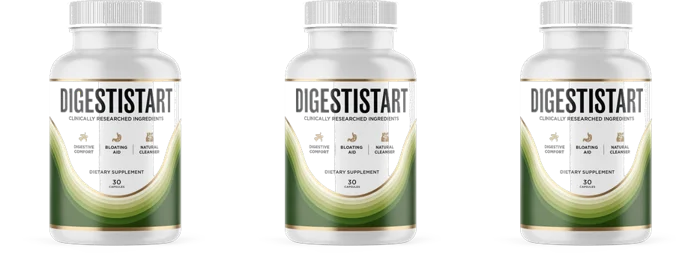
We found no published trial of DigestiStart. The label says "Clinically Researched Ingredients"[1], which means someone has studied the herbs, for anything, in any dose.
Replication
The single-herb trials that do exist are small. Eucommia lowered blood pressure at 3 g a day for 2 weeks in 30 people but showed no difference at 1.5 g a day for 8 weeks in 24 people[5].
DigestiStart claims vs what the evidence supports
Most DigestiStart claims are either untested or rest on a condition medicine does not recognize. The table sets each vendor claim, quoted from the sales page read November 5, 2026[1], against what the sources show.
| Vendor claim | Reasonable reading | Limitation |
|---|---|---|
| Digestive issues come from "gut paralysis" caused by lead in cans | Not a recognized condition | The vendor's reference is one lead poisoning case report[2] |
| "Clear out all the lead from your gut" | No label herb is shown to remove lead | Lead exposure is checked with a blood test |
| 11 ingredients "supported by multiple clinical studies" | A few herbs have small trials for other outcomes | None for constipation, bloating, IBS or GERD |
| Helps chronic constipation, bloating, GERD, IBS or acid reflux | Untested | No trial of the capsule |
| More energy, less fatigue, weight loss | Untested | A schisandra weight trial found no effect vs placebo[8] |
| "More than 341,760 Americans" and 13,513 reviews | Vendor figures | Cannot be checked independently |
If you still want to try it, buy only from the vendor's BuyGoods checkout and keep the 60-day refund rules in mind.
Which ingredients matter most?
Four ingredients carry most of the weight, and each has a dose, form or population mismatch with its studies.
- Cistanche: the only herb tied to a constipation trial, and that was a multi-herb liquid at gram doses[3]. Its own share of a 500 mg blend is undisclosed.
- Polygala: the documented gut finding points the wrong way. Its saponins are a gastrointestinal irritant and changed gut motility in isolated intestine tissue[4].
- Eucommia: studied for blood pressure at 1.5 to 3 g a day of a standardized extract[5], not for digestion.
- Wild yam: the label form is Chinese yam (Dioscorea opposita). The one placebo trial on file used Mexican wild yam (D. villosa) cream for menopause and found no difference[7].
Achyranthes has no human trials at all; a 2026 review says it "lacks clinical trial validation"[9]. The study populations (older adults, people with high blood pressure, healthy volunteers) also differ from people with IBS or reflux.
What results are realistic to expect?
No trial measured a digestive result for any DigestiStart herb, so there is no evidence-based timeline for less bloating or easier bowel movements. The trials that exist measured other things over 2 to 12 weeks, such as blood pressure[5] or memory and thinking scores with a cistanche combination over 90 days[6].
The vendor advises using it for at least 3 months, while its refund window is 60 days from delivery[10]. If you try it, judge it inside the refund window and stop if your symptoms get worse. Our DigestiStart price guide covers the order math.
When should you see a doctor instead?
Ongoing constipation, reflux or IBS-type symptoms deserve a medical check before any supplement. Diet changes covered in our guide on how to reduce bloating are a safer first step for mild symptoms.
See a doctor right away if you have:
- blood in your stool, or black, tarry stools
- weight loss you cannot explain
- trouble or pain when swallowing, or repeated vomiting
- severe or worsening belly pain, or a swollen, hard belly
- no bowel movement and no gas passed, with pain
- chest pain, which can come from the heart even when it feels like heartburn
- a lasting change in bowel habits after age 45
Evidence conclusion
DigestiStart is an untested blend of herbs with no digestive trials at its doses, sold on a theory medicine does not recognize. Here is the answer to each buying question in one line.
| Decision question | Assessment, checked November 5, 2026 |
|---|---|
| Is the "lead gut paralysis" theory sound? | No; one case report of lead poisoning[2] |
| Do the herbs have gut trials at label doses? | No; the closest is a gram-dose multi-herb liquid[3] |
| Has the capsule been tested? | No published trial found |
| Are doses disclosed? | No; one 500 mg proprietary blend[1] |
| Any safety flags? | Yes; see DigestiStart side effects |
For seller and refund facts, read is DigestiStart legit. Our method is on the how we research page.
Back to the DigestiStart overview.
Frequently asked questions
Does DigestiStart really work for constipation?
There is no evidence that it does. No herb on the label has a human constipation trial at the roughly 45 mg per herb a 500 mg blend allows, and the capsule is untested. The closest study used a multi-herb cistanche liquid at 3 to 6 g a day.
How long does DigestiStart take to work?
No study measured a digestive result, so there is no evidence-based timeline. The vendor suggests at least 3 months, but its refund window is 60 days from delivery. If you try it, decide inside that window and stop if symptoms get worse.
Is gut paralysis from lead a real condition?
No. Gut paralysis caused by lead in cans is not a recognized medical diagnosis. The vendor supports the idea with one case report of chronic lead poisoning. Lead exposure is a medical issue that a doctor checks with a blood test.
Can DigestiStart remove lead from your body?
Nothing on the DigestiStart label is shown to remove lead. The 11 herbs are traditional Chinese medicine roots, seeds and fruits with no lead studies cited. Anyone worried about lead exposure should ask a doctor for a blood lead test.
Has DigestiStart been tested in a clinical trial?
We found no published trial of the DigestiStart capsule. The label says Clinically Researched Ingredients, which only means the herbs have been studied for something, at some dose, often in animals or as part of other formulas.
Sources
- DigestiStart sales page and Supplement Facts label. DigestiStart (vendor), read November 5, 2026.
- DigestiStart references. DigestiStart (vendor), read November 5, 2026.
- Congrong Runtong liquid vs placebo for constipation (PMID 41759423). PubMed, read November 5, 2026.
- Polygala saponins: gastrointestinal irritation and gut motility (PMID 25705699). PubMed, read November 5, 2026.
- Eucommia bark extract and blood pressure in humans (PMID 22214253). PubMed, read November 5, 2026.
- Cistanche plus ginkgo tablet, 90-day randomized trial on cognition (PMID 38972848). PubMed, read November 5, 2026.
- Wild yam cream vs placebo in menopausal women (PMID 11428178). PubMed, read November 5, 2026.
- Schisandra fruit extract in obese women, 12-week randomized trial (PMID 26048342). PubMed, read November 5, 2026.
- Achyranthes bidentata pharmacology and safety, 2026 review (PMID 42302952). PubMed, read November 5, 2026.
- DigestiStart refund policy. DigestiStart (vendor), read November 5, 2026.
This page is general information, not medical advice. Dietary supplements are not reviewed by the FDA for safety or effectiveness before they are sold and are not intended to diagnose, treat, cure or prevent any disease. Talk to your doctor before taking any supplement, especially if you are pregnant, nursing, take medication or have a health condition.